
Research compounds
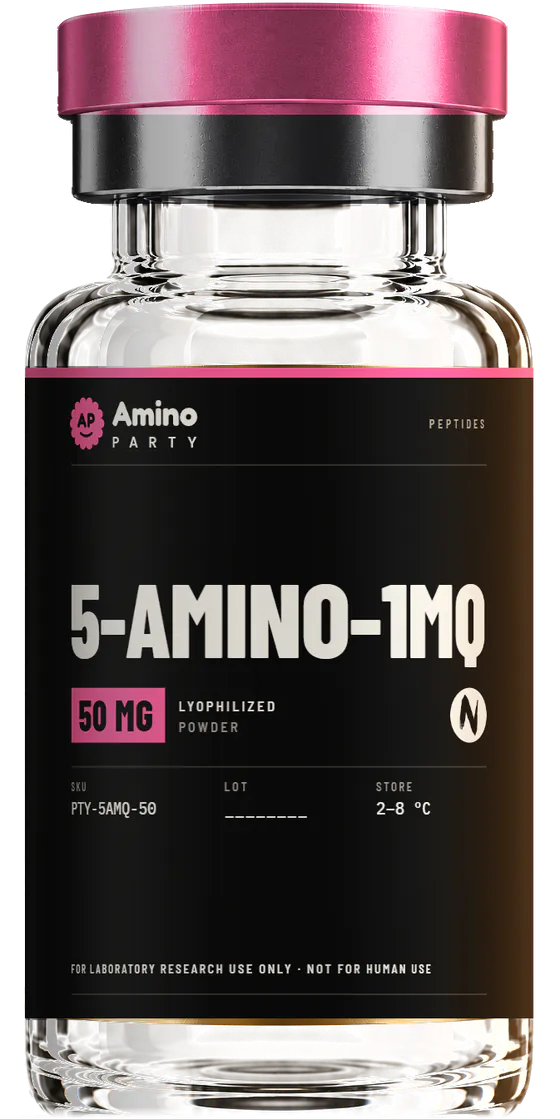
5-Amino-1MQ
Despite often being grouped with peptides, 5-Amino-1MQ (5-amino-1-methylquinolinium) is a small molecule. It crosses cell membranes and blocks nicotinamide N-methyltransferase, an enzyme usually shortened to NNMT. Researchers at the University of Texas Medical Branch first reported it in 2018.
- Container
- Glass vial, crimp seal, flip-top cap
- Storage
- 2 to 8 °C, desiccated
- Paperwork
- Lot certificate (HPLC + mass spec) shown before you pay
Lot certificates
You’ll see American Peptides on the lab’s copy. They’re our supplier.
- 50 mg, lot 5AM1MQ50-0803: 99.87% purity (RP-HPLC), 50.98 mg measured, identity confirmed by mass spec. Issued 2026-08-28 by Bioviridian Inc.. Verify certificate COA7587
Our vials are filled from lots made by our supplier, American Peptides, and tested by Bioviridian Inc.The laboratory’s original certificate lists American Peptides as the vendor. Look up the code at bioviridians.com to check it.
What researchers study it for
- Mice made obese by a high-fat diet
- Liver fat and blood-sugar handling in mice
- Muscle repair in old mice
- NAD+ and methyl-group metabolism
How it is thought to work
The compound blocks NNMT, an enzyme in the cell's cytosol that adds a methyl group to nicotinamide. When fat cells in culture were exposed to NNMT blockers, the enzyme's product 1-methylnicotinamide fell, NAD+ and S-adenosylmethionine rose, and the cells made less new fat. The researchers suggest these changes explain what they observed in mice. So far, that idea rests only on cell and mouse experiments.
Where the research stands
Preclinical only: mouse and cell work. Everything published so far comes from mice and cultured cells, and most of it from a single lab and the company connected to it. ClinicalTrials.gov lists no human trials.
Sources
- Neelakantan H, et al. (2018). Selective and membrane-permeable small molecule inhibitors of nicotinamide N-methyltransferase reverse high fat diet-induced obesity in mice. Biochemical Pharmacology.
- Neelakantan H, et al. (2019). Small molecule nicotinamide N-methyltransferase inhibitor activates senescent muscle stem cells and improves regenerative capacity of aged skeletal muscle. Biochemical Pharmacology.
- Babula JJ, et al. (2024). Nicotinamide N-methyltransferase inhibition mitigates obesity-related metabolic dysfunction. Diabetes, Obesity & Metabolism.
- Dimet-Wiley AL, et al. (2024). Nicotinamide N-methyltransferase inhibition mimics and boosts exercise-mediated improvements in muscle function in aged mice. Scientific Reports.
For laboratory research use only. Not a drug, food, supplement or cosmetic; not for human or veterinary use. Nothing on this page is medical advice or a usage guide.