
Research peptides
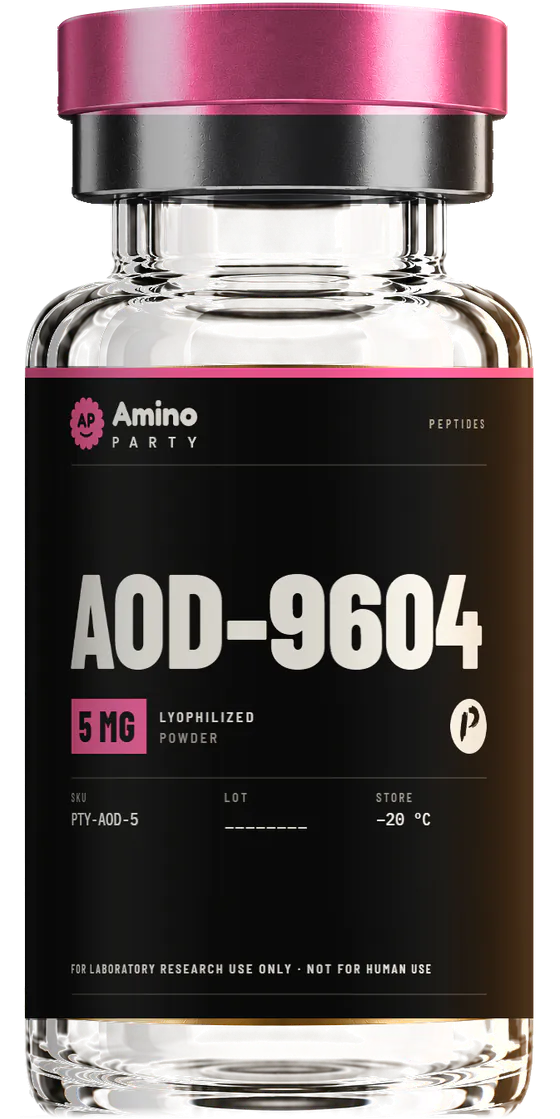
AOD-9604
AOD-9604 is a man-made peptide built from a small piece of human growth hormone: amino acids 177 through 191 at the molecule's C-terminal end, with one extra tyrosine added at the front. It was originally pursued as a possible medicine for obesity.
- Container
- Glass vial, crimp seal, flip-top cap
- Storage
- -20 °C, desiccated
- Paperwork
- Lot certificate (HPLC + mass spec) shown before you pay
What researchers study it for
- How fat is processed in obese rodents
- Its history as an obesity drug candidate
- Rabbit cartilage experiments
- Methods for detecting it in anti-doping testing
How it is thought to work
Nobody has pinned down exactly how it acts. Obese mice that received it gained less weight and burned more fat, and yet in the test tube the peptide neither attached to the growth hormone receptor nor made cells multiply. When mice lacking the beta-3 adrenergic receptor were studied, the longer-term changes disappeared, but the researchers still judged that this receptor is not what the peptide acts on directly.
Where the research stands
Obesity candidate that was dropped; sparse human data. What exists in people is thin and mostly short in duration. A 2026 review, drawing largely on company reports rather than published trials, says a 24-week obesity study did not meet its main weight-loss goal. No regulator has approved it, and FDA notes that little safety information is available.
Sources
- Heffernan MA, et al. (2001). Increase of fat oxidation and weight loss in obese mice caused by chronic treatment with human growth hormone or a modified C-terminal fragment. International Journal of Obesity and Related Metabolic Disorders.
- Heffernan M, et al. (2001). The effects of human GH and its lipolytic fragment (AOD9604) on lipid metabolism following chronic treatment in obese mice and beta(3)-AR knock-out mice. Endocrinology.
- Cox HD, et al. (2015). Detection and in vitro metabolism of AOD9604. Drug Testing and Analysis.
- Dominikowski A, et al. (2026). The emerging landscape of performance-enhancing peptides modulating GH-IGF1 axis: bridging the gap between clinical evidence and patient self-administration. Frontiers in Endocrinology.
For laboratory research use only. Not a drug, food, supplement or cosmetic; not for human or veterinary use. Nothing on this page is medical advice or a usage guide.