
Research peptides
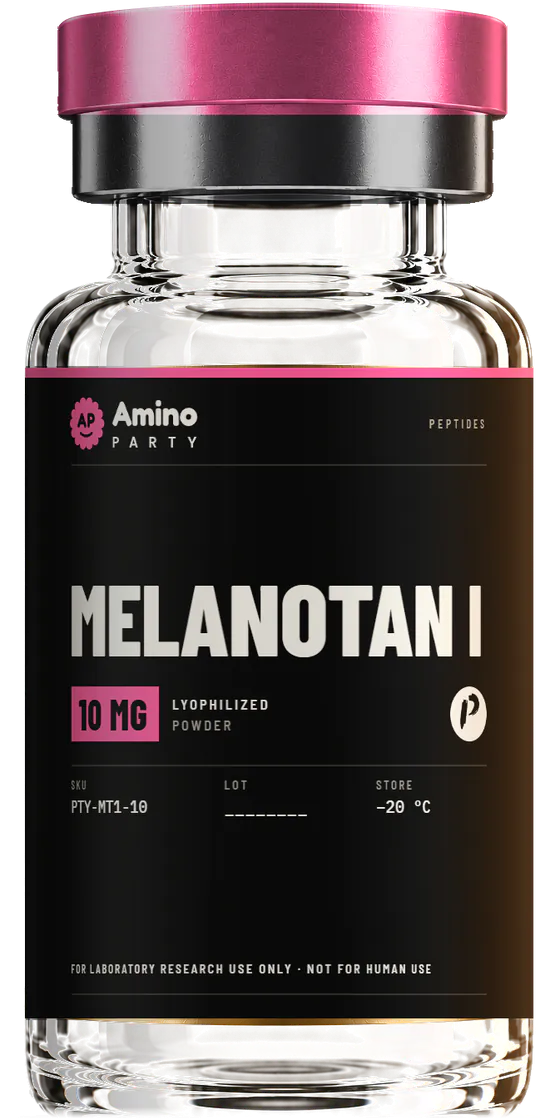
Melanotan I
Before it was called afamelanotide, this compound went by Melanotan I. Chemically it is written [Nle4, D-Phe7]-alpha-MSH: a synthetic peptide of 13 amino acids that mirrors alpha-melanocyte-stimulating hormone except for two swapped residues. Chemists made it for the first time in 1980.
- Container
- Glass vial, crimp seal, flip-top cap
- Storage
- -20 °C, desiccated
- Paperwork
- Lot certificate (HPLC + mass spec) shown before you pay
Lot certificates
You’ll see American Peptides on the lab’s copy. They’re our supplier.
- 10 mg, lot MT110-0318: 99.80% purity (RP-HPLC), 10.78 mg measured, identity confirmed by mass spec. Issued 2026-04-03 by Bioviridian Inc.. Verify certificate COA3394
Our vials are filled from lots made by our supplier, American Peptides, and tested by Bioviridian Inc.The laboratory’s original certificate lists American Peptides as the vendor. Look up the code at bioviridians.com to check it.
What researchers study it for
- Erythropoietic protoporphyria
- Eumelanin and skin pigment
- Vitiligo
- Light-triggered skin conditions: polymorphic light eruption and solar urticaria
How it is thought to work
Afamelanotide activates melanocortin receptors and attaches mainly to the melanocortin-1 subtype. When that receptor signals, skin cells make more eumelanin, and this happens whether or not the skin has seen sunlight or a UV lamp. The pathway is well characterized and appears in the FDA label.
Where the research stands
Approved medicine under the name afamelanotide (Scenesse). Afamelanotide has held marketing approval in the EU since 2014 and in the US since 2019, for adults with erythropoietic protoporphyria, backed by randomized placebo-controlled trials. That status belongs to the licensed product alone.
Sources
- Langendonk JG, et al. (2015). Afamelanotide for Erythropoietic Protoporphyria. The New England Journal of Medicine.
- Dorr RT, et al. (2000). Increased eumelanin expression and tanning is induced by a superpotent melanotropin [Nle4-D-Phe7]-alpha-MSH in humans. Photochemistry and Photobiology.
- Minder EI, et al. (2017). Pharmacokinetics and Pharmacodynamics of Afamelanotide and its Clinical Use in Treating Dermatologic Disorders. Clinical Pharmacokinetics.
- Wu J, Cotliar R. (2021). Afamelanotide: An Orphan Drug with Potential for Broad Dermatologic Applications. Journal of Drugs in Dermatology.
For laboratory research use only. Not a drug, food, supplement or cosmetic; not for human or veterinary use. Nothing on this page is medical advice or a usage guide.