
Research peptides
MOTS-c
MOTS-c is a 16-residue peptide that comes from the mitochondria. The gene for it is a small open reading frame tucked inside the 12S rRNA section of mitochondrial DNA. Researchers first reported it in 2015, and most of what is known comes from metabolic experiments in cultured cells and mice.
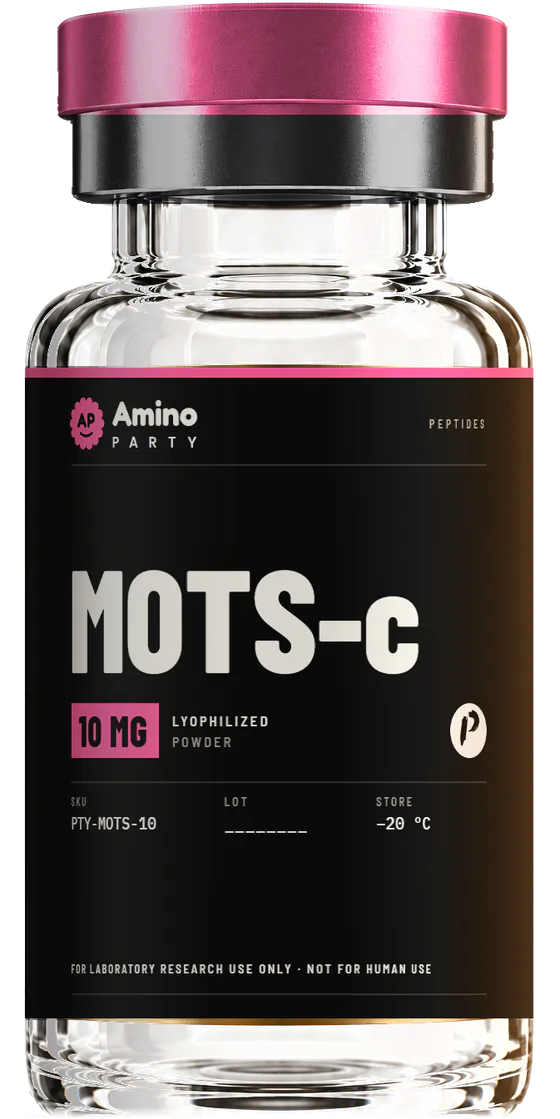
- Container
- Glass vial, crimp seal, flip-top cap
- Storage
- -20 °C, desiccated
- Paperwork
- Lot certificate (HPLC + mass spec) shown before you pay
Lot certificates
You’ll see American Peptides on the lab’s copy. They’re our supplier.
- 10 mg, lot MOTS10-0803: 99.84% purity (RP-HPLC), 10.62 mg measured, identity confirmed by mass spec. Issued 2026-08-28 by Bioviridian Inc.. Verify certificate COA7589
- 40 mg, lot MOTS40-0803: 99.88% purity (RP-HPLC), 40.51 mg measured, identity confirmed by mass spec. Issued 2026-08-28 by Bioviridian Inc.. Verify certificate COA7618
Our vials are filled from lots made by our supplier, American Peptides, and tested by Bioviridian Inc.The laboratory’s original certificate lists American Peptides as the vendor. Look up the code at bioviridians.com to check it.
What researchers study it for
- Insulin response and metabolic balance
- Energy handling in skeletal muscle
- Mice made obese by diet
- Loss of physical capacity in aging mice
- How blood levels shift with exercise
How it is thought to work
The first cell and mouse papers found that skeletal muscle was the main site of action: MOTS-c slowed the folate cycle and the purine-building pathway tied to it, and that in turn switched on AMPK, a sensor of cellular energy status. Follow-up studies described it influencing genes in the nucleus that govern metabolism and protein quality control. In people, muscle and blood levels of naturally made MOTS-c have been observed to rise with exercise.
Where the research stands
Largely cell and mouse research. Most of what is known comes from cells and mice. In people the data are observational, for example the way blood levels track exercise, and we found no finished controlled trial of MOTS-c itself.
Sources
- Lee C, Zeng J, Drew BG, Sallam T, Martin-Montalvo A, Wan J, Kim SJ, Mehta H, Hevener AL, de Cabo R, Cohen P (2015). The mitochondrial-derived peptide MOTS-c promotes metabolic homeostasis and reduces obesity and insulin resistance.. Cell Metabolism.
- Reynolds JC, Lai RW, Woodhead JST, Joly JH, Mitchell CJ, Cameron-Smith D, Lu R, Cohen P, Graham NA, Benayoun BA, Merry TL, Lee C (2021). MOTS-c is an exercise-induced mitochondrial-encoded regulator of age-dependent physical decline and muscle homeostasis.. Nature Communications.
- Kong BS, Lee C, Cho YM (2023). Mitochondrial-Encoded Peptide MOTS-c, Diabetes, and Aging-Related Diseases.. Diabetes & Metabolism Journal.
Read more
For laboratory research use only. Not a drug, food, supplement or cosmetic; not for human or veterinary use. Nothing on this page is medical advice or a usage guide.