
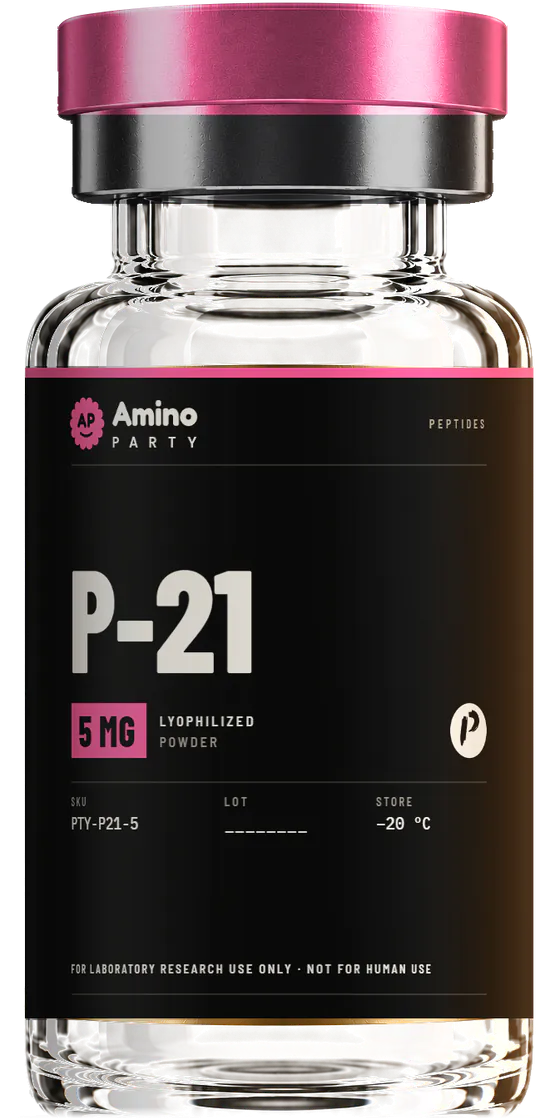
Research peptides
P-21
P-21, which some papers spell P021, is a tiny synthetic molecule classed as peptidergic, with the structure Ac-DGGL(A)G-NH2. Its design borrows the active segment of ciliary neurotrophic factor (CNTF) and adds a glycine bearing an adamantyl group. The compound originated in Iqbal's laboratory in New York.
- Container
- Glass vial, crimp seal, flip-top cap
- Storage
- -20 °C, desiccated
- Paperwork
- Lot certificate (HPLC + mass spec) shown before you pay
Lot certificates
You’ll see American Peptides on the lab’s copy. They’re our supplier.
- 5 mg, lot P21-5-0318: 99.80% purity (RP-HPLC), 5.25 mg measured, identity confirmed by mass spec. Issued 2026-06-17 by Bioviridian Inc.. Verify certificate COA4866
Our vials are filled from lots made by our supplier, American Peptides, and tested by Bioviridian Inc.The laboratory’s original certificate lists American Peptides as the vendor. Look up the code at bioviridians.com to check it.
What researchers study it for
- Alzheimer-like changes in genetically modified mice
- Memory and aging in rats
- New neuron formation and synaptic plasticity in the hippocampus
- Models of Down syndrome and CDKL5 deficiency
How it is thought to work
According to the group that made it, the compound blocks leukemia inhibitory factor (LIF) signaling and raises brain-derived neurotrophic factor (BDNF), which in turn lowers GSK-3beta activity. No human has been studied. A 2024 paper in CDKL5-deficient mice saw effects in cultured cells but found no BDNF rise in the living animals and only modest behavioral change.
Where the research stands
Preclinical only. The published record is confined to cells, mice and rats, and almost every paper involves the same research group. ClinicalTrials.gov shows no human trial of this compound, and it is not an approved medicine.
Sources
- Kazim SF, et al. (2014). Disease modifying effect of chronic oral treatment with a neurotrophic peptidergic compound in a triple transgenic mouse model of Alzheimer's disease. Neurobiology of Disease.
- Bolognin S, et al. (2014). Rescue of cognitive-aging by administration of a neurogenic and/or neurotrophic compound. Neurobiology of Aging.
- Kazim SF, Iqbal K. (2016). Neurotrophic factor small-molecule mimetics mediated neuroregeneration and synaptic repair: emerging therapeutic modality for Alzheimer's disease. Molecular Neurodegeneration.
- Mottolese N, et al. (2024). Effects of a ciliary neurotrophic factor (CNTF) small-molecule peptide mimetic in an in vitro and in vivo model of CDKL5 deficiency disorder. Journal of Neurodevelopmental Disorders.
For laboratory research use only. Not a drug, food, supplement or cosmetic; not for human or veterinary use. Nothing on this page is medical advice or a usage guide.