
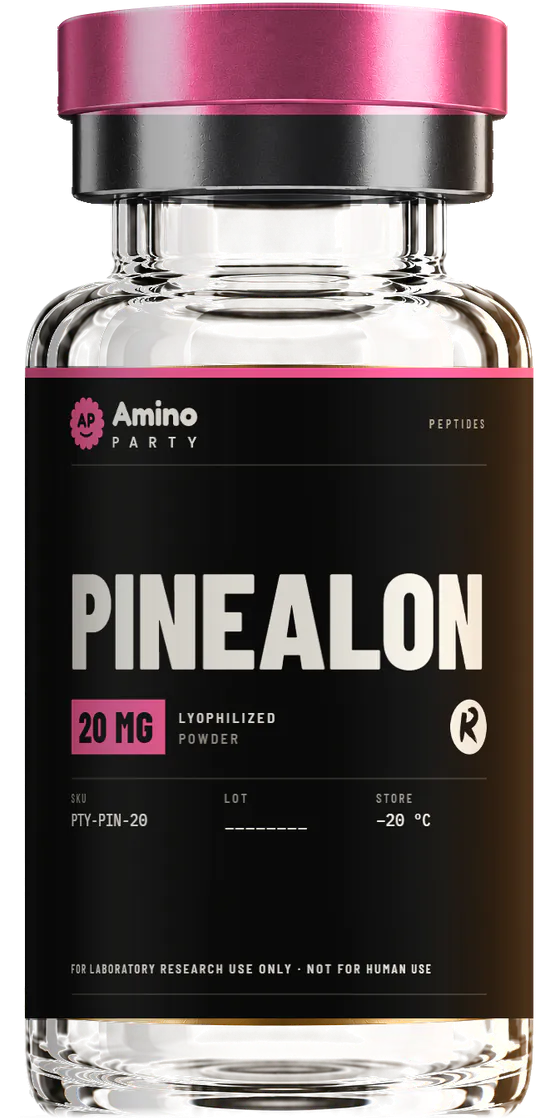
Bioregulators
Pinealon
Pinealon is a synthetic three-amino-acid peptide, Glu-Asp-Arg, often abbreviated EDR. It belongs to the family of short 'bioregulator' peptides investigated mostly by the St. Petersburg Institute of Bioregulation and Gerontology.
- Container
- Glass vial, crimp seal, flip-top cap
- Storage
- -20 °C, desiccated
- Paperwork
- Lot certificate (HPLC + mass spec) shown before you pay
Lot certificates
You’ll see American Peptides on the lab’s copy. They’re our supplier.
- 20 mg, lot PINE20-0803: 99.68% purity (RP-HPLC), 20.80 mg measured, identity confirmed by mass spec. Issued 2026-08-28 by Bioviridian Inc.. Verify certificate COA7610
Our vials are filled from lots made by our supplier, American Peptides, and tested by Bioviridian Inc.The laboratory’s original certificate lists American Peptides as the vendor. Look up the code at bioviridians.com to check it.
What researchers study it for
- Oxidative stress in neurons grown in culture
- Rat pups exposed to high homocysteine before birth
- Alzheimer's disease cell models
- Binding of the peptide to DNA and histones
How it is thought to work
No mechanism has been established. In cell experiments, the peptide was linked to less build-up of reactive oxygen species, fewer cells dying by necrosis and a delay in ERK 1/2 activation. A 2020 review from the same group suggests it gets into cells and attaches to histones or nucleic acids, altering gene expression, but the authors themselves call this an assumption.
Where the research stands
Mostly preclinical; a few small Russian human reports. The bulk of the literature is cell and rat work from a single group. Human reports are small and appear chiefly in Russian-language journals. ClinicalTrials.gov lists no trials, and no FDA-approved product exists.
Sources
- Khavinson V, et al. (2011). Pinealon increases cell viability by suppression of free radical levels and activating proliferative processes. Rejuvenation Research.
- Arutjunyan A, et al. (2012). Pinealon protects the rat offspring from prenatal hyperhomocysteinemia. International Journal of Clinical and Experimental Medicine.
- Khavinson V, et al. (2020). EDR Peptide: Possible Mechanism of Gene Expression and Protein Synthesis Regulation Involved in the Pathogenesis of Alzheimer's Disease. Molecules.
- Meshchaninov VN, et al. (2015). [EFFECT OF SYNTHETIC PEPTIDES ON AGING OF PATIENTS WITH CHRONIC POLYMORBIDITY AND ORGANIC BRAIN SYNDROME OF THE CENTRAL NERVOUS SYSTEM IN REMISSION]. Advances in Gerontology (Uspekhi Gerontologii).
For laboratory research use only. Not a drug, food, supplement or cosmetic; not for human or veterinary use. Nothing on this page is medical advice or a usage guide.