
Sprays
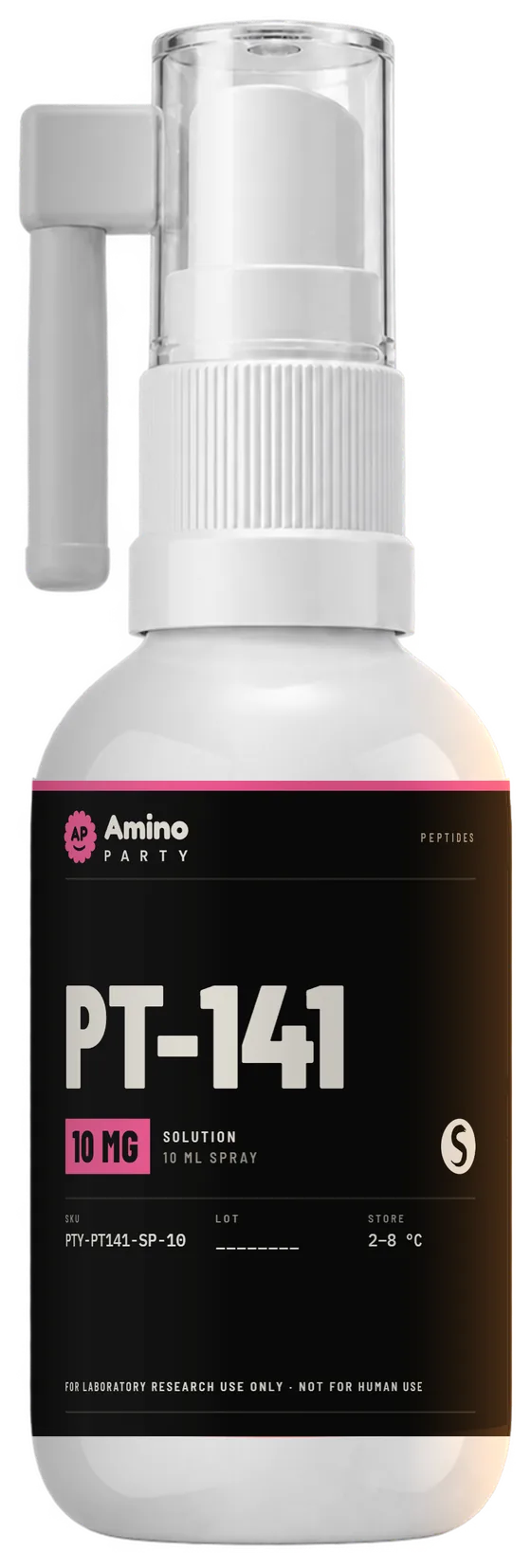
PT-141 spray
PT-141 was the working name for bremelanotide during development. It is a synthetic peptide with seven amino acids arranged in a ring, modeled on alpha-melanocyte-stimulating hormone, and has been described as a derivative of Melanotan II.
- Container
- 10 mL spray bottle, pump and overcap
- Storage
- 2 to 8 °C, protect from light
- Per bottle
- 10 mg PT-141 · 1 mg/mL
- Paperwork
- Lot certificate (HPLC + mass spec) shown before you pay
What researchers study it for
- Hypoactive sexual desire disorder in women before menopause
- Sexual arousal disorder in women
- Erectile function studies in men
- How the melanocortin-4 receptor signals in the brain
How it is thought to work
Bremelanotide switches on melanocortin receptors without much selectivity between subtypes; the melanocortin-4 receptor is thought to matter most. Work in animals points to hypothalamic neurons and a rise in dopamine release. Even so, the FDA label says plainly that how the drug produces its clinical effect is not known.
Where the research stands
Approved medicine under the name bremelanotide (Vyleesi). US regulators cleared bremelanotide in 2019 for one specific diagnosis: acquired, generalized hypoactive sexual desire disorder in women who have not reached menopause. Two randomized phase 3 trials supported that decision, and a subsequent re-analysis argued the gain was modest. None of this extends beyond the licensed medicine.
Sources
- Kingsberg SA, et al. (2019). Bremelanotide for the Treatment of Hypoactive Sexual Desire Disorder: Two Randomized Phase 3 Trials. Obstetrics and Gynecology.
- Dhillon S, Keam SJ. (2019). Bremelanotide: First Approval. Drugs.
- Pfaus JG, et al. (2022). The neurobiology of bremelanotide for the treatment of hypoactive sexual desire disorder in premenopausal women. CNS Spectrums.
- Diamond LE, et al. (2006). An effect on the subjective sexual response in premenopausal women with sexual arousal disorder by bremelanotide (PT-141), a melanocortin receptor agonist. The Journal of Sexual Medicine.
For laboratory research use only. Not a drug, food, supplement or cosmetic; not for human or veterinary use. Nothing on this page is medical advice or a usage guide.