
Sprays
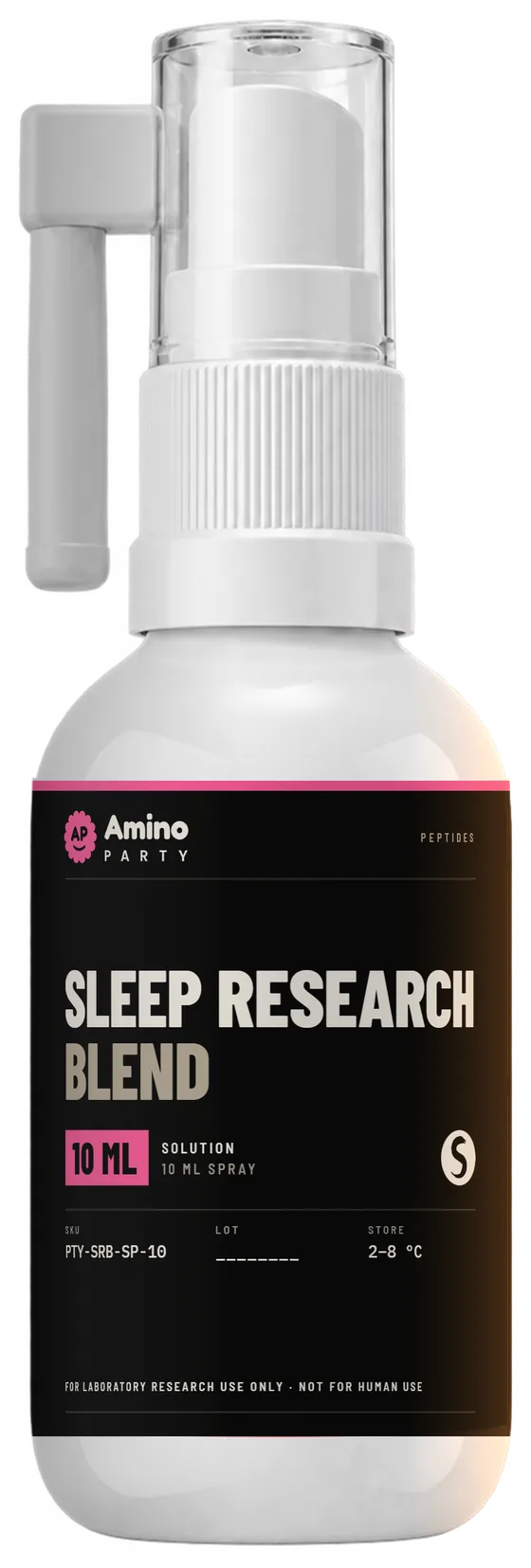
Sleep research blend spray
Four ingredients in one spray: DSIP, Pinealon, melatonin and GABA. They have been researched one by one, and the depth of human data behind them ranges from considerable to almost none. The notes below describe each on its own and not the mixture.
- Container
- 10 mL spray bottle, pump and overcap
- Storage
- 2 to 8 °C, protect from light
- In the vial
- DSIP 10 mg + Pinealon 10 mg + melatonin 50 mg + GABA 250 mg
- Per bottle
- DSIP 10 mg · Pinealon 10 mg · melatonin 50 mg · GABA 250 mg
- Paperwork
- Lot certificate (HPLC + mass spec) shown before you pay
What researchers study it for
- Sleep and delta-wave EEG activity in animals
- Long-standing insomnia in small human trials
- Oxidative stress in neurons grown in culture
- Rat pups exposed to high homocysteine before birth
- Long-term insomnia
How it is thought to work
DSIP: How DSIP might act is unknown. Pinealon: No mechanism has been established. Melatonin: Melatonin acts on two high-affinity G protein-coupled receptors, MT1 and MT2, a well-established finding. GABA: Inside the nervous system, GABA opens GABA-A receptors, chloride channels that dampen neuronal firing; this part is settled science.
Where the research stands
Blend of research compounds. Each component is studied separately; as a combined vial it has no dedicated published research. The least-established component is DSIP: small, older human studies; not an approved medicine.
Sources
- Schoenenberger GA, Monnier M. (1977). Characterization of a delta-electroencephalogram (-sleep)-inducing peptide. Proceedings of the National Academy of Sciences of the United States of America.
- Graf MV, Kastin AJ. (1984). Delta-sleep-inducing peptide (DSIP): a review. Neuroscience and Biobehavioral Reviews.
- Khavinson V, et al. (2011). Pinealon increases cell viability by suppression of free radical levels and activating proliferative processes. Rejuvenation Research.
- Arutjunyan A, et al. (2012). Pinealon protects the rat offspring from prenatal hyperhomocysteinemia. International Journal of Clinical and Experimental Medicine.
- Liu J, et al. (2016). MT1 and MT2 Melatonin Receptors: A Therapeutic Perspective. Annual Review of Pharmacology and Toxicology.
- Choi K, et al. (2022). Efficacy of melatonin for chronic insomnia: Systematic reviews and meta-analyses. Sleep Medicine Reviews.
- Sigel E, Steinmann ME. (2012). Structure, function, and modulation of GABA(A) receptors. The Journal of Biological Chemistry.
- Boonstra E, et al. (2015). Neurotransmitters as food supplements: the effects of GABA on brain and behavior. Frontiers in Psychology.
For laboratory research use only. Not a drug, food, supplement or cosmetic; not for human or veterinary use. Nothing on this page is medical advice or a usage guide.