
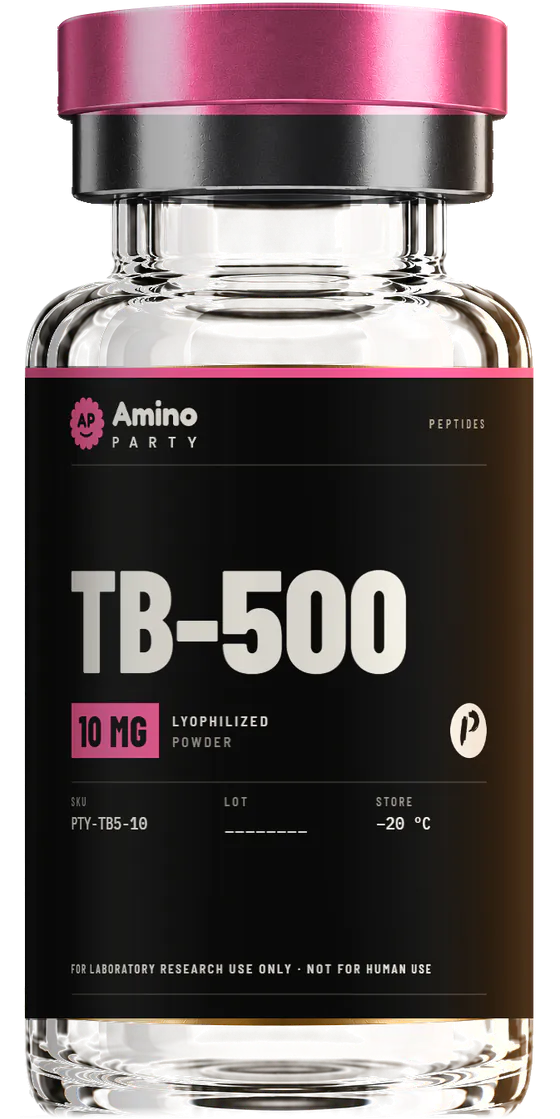
Research peptides
TB-500
Also known as Thymosin beta-4 fragment
"TB-500" is a product label, not a defined chemical name. When chemists analyzed items sold under it, they found a short piece of thymosin beta-4 (positions 17 to 23, Ac-LKKTETQ) with an acetyl group on its N-terminus. Some writers also use the term for the full thymosin beta-4 protein.
- Container
- Glass vial, crimp seal, flip-top cap
- Storage
- -20 °C, desiccated
- Paperwork
- Lot certificate (HPLC + mass spec) shown before you pay
Lot certificates
You’ll see American Peptides on the lab’s copy. They’re our supplier.
- 10 mg, lot TB10-0803: 99.68% purity (RP-HPLC), 10.23 mg measured, identity confirmed by mass spec. Issued 2026-08-28 by Bioviridian Inc.. Verify certificate COA7595
Our vials are filled from lots made by our supplier, American Peptides, and tested by Bioviridian Inc.The laboratory’s original certificate lists American Peptides as the vendor. Look up the code at bioviridians.com to check it.
What researchers study it for
- Detection methods and breakdown products for drug testing
- Lab assays of how cells move and close gaps
- The part of thymosin beta-4 that grabs actin
- One rat study of tendon repair
How it is thought to work
The parent molecule, thymosin beta-4, is a 43-residue protein that holds onto actin. The LKKTETQ stretch is where that actin contact happens, and lab experiments have tied this stretch to cell movement and new vessel formation. Nobody has clearly shown that the acetylated short piece does the same things; in fact a 2024 paper pointed out that the biology of TB-500 itself had never been written up.
Where the research stands
Lab and animal work only. Studies of the fragment on its own come from the bench, from animals and from drug-testing labs. WADA lists thymosin-β4 and its derivatives, naming TB-500, under S2.
Sources
- Esposito S, et al. (2012). Synthesis and characterization of the N-terminal acetylated 17-23 fragment of thymosin beta 4 identified in TB-500, a product suspected to possess doping potential. Drug Testing and Analysis.
- Ho EN, et al. (2012). Doping control analysis of TB-500, a synthetic version of an active region of thymosin β4, in equine urine and plasma by liquid chromatography-mass spectrometry. Journal of Chromatography A.
- Sosne G, et al. (2010). Biological activities of thymosin beta4 defined by active sites in short peptide sequences. FASEB Journal.
- Rahaman KA, et al. (2024). Simultaneous quantification of TB-500 and its metabolites in in-vitro experiments and rats by UHPLC-Q-Exactive orbitrap MS/MS and their screening by wound healing activities in-vitro. Journal of Chromatography B.
Read more
For laboratory research use only. Not a drug, food, supplement or cosmetic; not for human or veterinary use. Nothing on this page is medical advice or a usage guide.