
Bioregulators
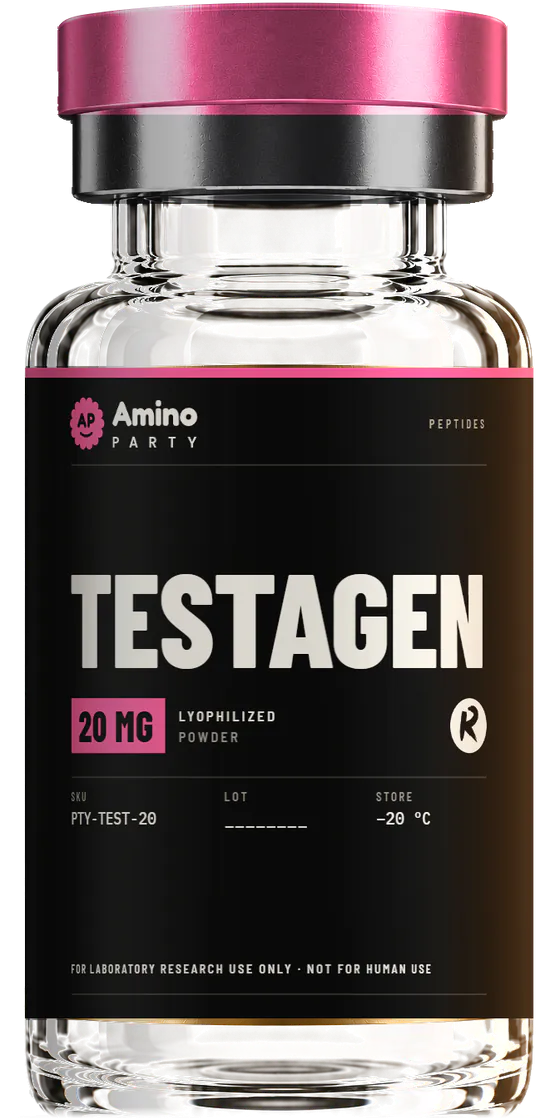
Testagen
Several publications apply the label Testagen to Lys-Glu-Asp-Gly, a synthetic peptide of four residues abbreviated KEDG. Elsewhere, groups working with this identical sequence explain that they built it to reflect which amino acids predominate in extracts of the front part of the pituitary gland.
- Container
- Glass vial, crimp seal, flip-top cap
- Storage
- -20 °C, desiccated
- Paperwork
- Lot certificate (HPLC + mass spec) shown before you pay
Lot certificates
You’ll see American Peptides on the lab’s copy. They’re our supplier.
- 20 mg, lot TESTA20-0528: 99.90% purity (RP-HPLC), 20.32 mg measured, identity confirmed by mass spec. Issued 2026-06-17 by Bioviridian Inc.. Verify certificate COA4864
Our vials are filled from lots made by our supplier, American Peptides, and tested by Bioviridian Inc.The laboratory’s original certificate lists American Peptides as the vendor. Look up the code at bioviridians.com to check it.
What researchers study it for
- Entry of the peptide into cell nuclei
- Binding of the peptide to DNA and histones
- Thyroid gland structure in chickens without a pituitary
- Differentiation of immune cells
How it is thought to work
No mechanism has been established. A fluorescent version of the peptide showed up in the cytoplasm, nucleus and nucleolus of HeLa cells, and in the test tube it bound short DNA fragments in a sequence-dependent way. The authors propose that this might affect gene activity, but that remains a hypothesis.
Where the research stands
Preclinical, with a very small body of literature. Research on how this peptide behaves is limited to cultured cells, biochemical assays and chickens. Across everything we read, nobody examined it in testicular tissue and nobody ran a human investigation; ClinicalTrials.gov likewise has no entry for it.
Sources
- Fedoreyeva LI, et al. (2011). Penetration of short fluorescence-labeled peptides into the nucleus in HeLa cells and in vitro specific interaction of the peptides with deoxyribooligonucleotides and DNA. Biochemistry (Moscow).
- Kuznik BI, Pateyuk AV, Rusaeva NS. (2008). Effect of tetrapeptides Lys-Glu-Asp-Gly and Ala-Glu-Asp-Gly on the structure and function of the thyroid gland in neonatally hypophysectomized chickens. Bulletin of Experimental Biology and Medicine.
- Khavinson V, et al. (2020). Peptide Regulation of Cell Differentiation. Stem Cell Reviews and Reports.
Read more
For laboratory research use only. Not a drug, food, supplement or cosmetic; not for human or veterinary use. Nothing on this page is medical advice or a usage guide.