
Bioregulators
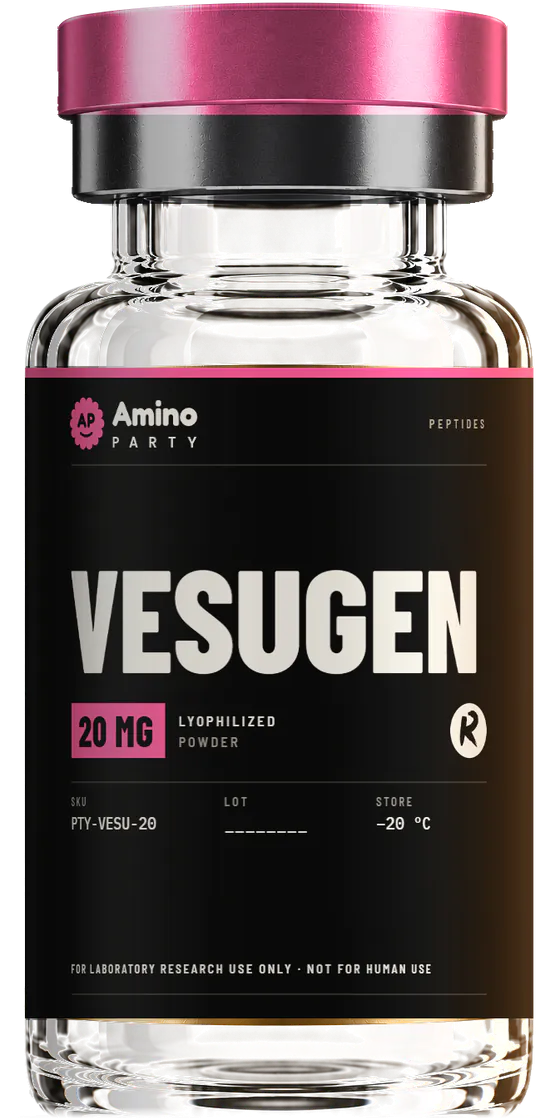
Vesugen
Vesugen is Lys-Glu-Asp (KED), a synthetic chain of three amino acids. Most of what has been written about it comes from the St. Petersburg Institute of Bioregulation and Gerontology, where researchers label it a peptide for blood vessels and treat it as part of their wider family of ultrashort bioregulators.
- Container
- Glass vial, crimp seal, flip-top cap
- Storage
- -20 °C, desiccated
- Paperwork
- Lot certificate (HPLC + mass spec) shown before you pay
Lot certificates
You’ll see American Peptides on the lab’s copy. They’re our supplier.
- 20 mg, lot VESU20-0528: 99.90% purity (RP-HPLC), 20.64 mg measured, identity confirmed by mass spec. Issued 2026-06-17 by Bioviridian Inc.. Verify certificate COA4865
Our vials are filled from lots made by our supplier, American Peptides, and tested by Bioviridian Inc.The laboratory’s original certificate lists American Peptides as the vendor. Look up the code at bioviridians.com to check it.
What researchers study it for
- Cultures of vascular endothelial cells
- Stem cells differentiating into neurons
- Alzheimer's disease cell models
- Fibroblast cultures as they age
How it is thought to work
No mechanism has been established. Cell-culture work reports shifts in markers of proliferation and differentiation, including Ki-67, nestin and GAP43. In a 2024 study, induced neurons grew more branched dendrites, but mitochondria, lysosomes and p16 were unchanged. The group proposes that the peptide binds directly to gene promoters, an idea resting mostly on computer docking.
Where the research stands
Mostly preclinical; a few small Russian human reports. Human evidence amounts to small studies in Russian-language journals, among them a before-and-after study of 41 patients. One research group accounts for almost all the work. ClinicalTrials.gov lists no trials, and no FDA-approved product exists.
Sources
- Khavinson VKh, et al. (2012). Peptides tissue-specifically stimulate cell differentiation during their aging. Bulletin of Experimental Biology and Medicine.
- Khavinson VK, Lin'kova NS, Umnov RS. (2021). Peptide KED: Molecular-Genetic Aspects of Neurogenesis Regulation in Alzheimer's Disease. Bulletin of Experimental Biology and Medicine.
- Kraskovskaya N, et al. (2024). Short Peptides Protect Fibroblast-Derived Induced Neurons from Age-Related Changes. International Journal of Molecular Sciences.
- Kitachev KV, et al. (2014). [The efficacy of peptide bioregulators of vessels in lower limbs chronic arterial insufficiency treatment in old and elderly people]. Advances in Gerontology (Uspekhi Gerontologii).
For laboratory research use only. Not a drug, food, supplement or cosmetic; not for human or veterinary use. Nothing on this page is medical advice or a usage guide.