
Copper & cosmetic
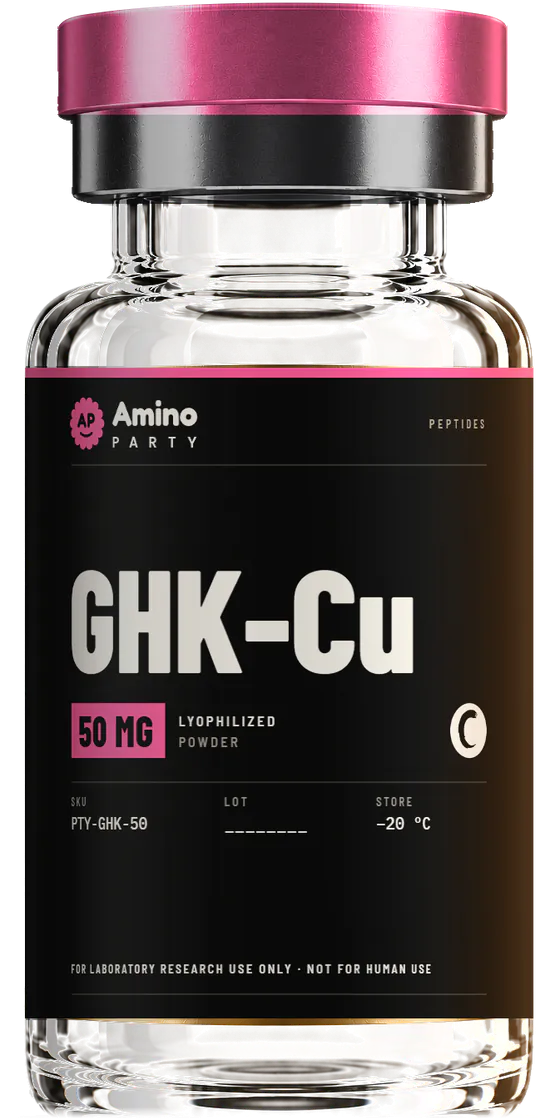
GHK-Cu
GHK-Cu is what forms when the three-amino-acid peptide glycyl-histidyl-lysine (GHK) binds a copper(II) ion. GHK itself turned up in human blood serum in a 1973 report, and it has since been detected in plasma, saliva and urine as well.
- Container
- Glass vial, crimp seal, flip-top cap
- Storage
- -20 °C, desiccated, protect from light
- Paperwork
- Lot certificate (HPLC + mass spec) shown before you pay
Lot certificates
You’ll see American Peptides on the lab’s copy. They’re our supplier.
- 50 mg, lot GHK50-0803: 99.77% purity (RP-HPLC), 51.02 mg measured, identity confirmed by mass spec. Issued 2026-08-28 by Bioviridian Inc.. Verify certificate COA7628
- 100 mg, lot GHK100-0803: 99.86% purity (RP-HPLC), 101.36 mg measured, identity confirmed by mass spec. Issued 2026-08-28 by Bioviridian Inc.. Verify certificate COA7578
Our vials are filled from lots made by our supplier, American Peptides, and tested by Bioviridian Inc.The laboratory’s original certificate lists American Peptides as the vendor. Look up the code at bioviridians.com to check it.
What researchers study it for
- Wound closure in animal skin
- Production of collagen and other matrix proteins
- Cosmetic skin-care studies
- Surveys of which genes switch on or off
How it is thought to work
GHK holds copper(II), and researchers have suggested the copper-bound version is the one that acts in experiments. Bench studies describe shifts in collagen and glycosaminoglycan output, in metalloproteinase enzymes, and in the activity of a wide range of genes. Whether any of that carries over to people has not been shown. A large share of the review articles were written by the group that discovered GHK, and that group has a business interest.
Where the research stands
Mostly lab and animal findings. What exists is mostly bench and animal research, together with some cosmetic skin trials; the FDA compounding review points out that human safety information is thin.
Sources
- Pickart L, Thaler MM. (1973). Tripeptide in human serum which prolongs survival of normal liver cells and stimulates growth in neoplastic liver. Nature New Biology.
- Pickart L, et al. (2015). GHK Peptide as a Natural Modulator of Multiple Cellular Pathways in Skin Regeneration. BioMed Research International.
- Pickart L, Margolina A. (2018). Regenerative and Protective Actions of the GHK-Cu Peptide in the Light of the New Gene Data. International Journal of Molecular Sciences.
Read more
For laboratory research use only. Not a drug, food, supplement or cosmetic; not for human or veterinary use. Nothing on this page is medical advice or a usage guide.