Peptide Storage and Stability Basics: Heat, Light, Moisture and the Freezer
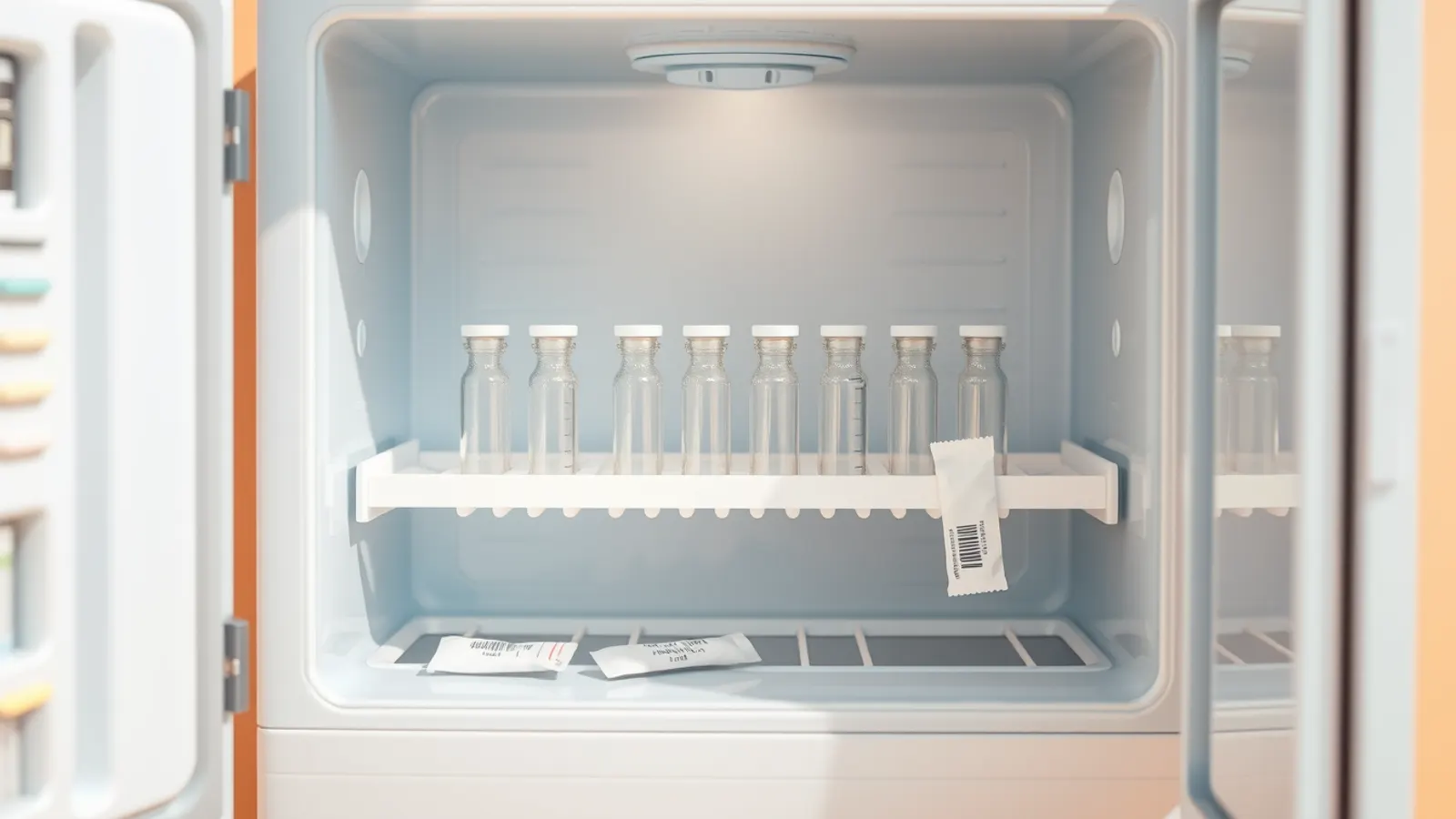
A peptide is a chain of amino acids held together by bonds that water, heat and light can all pick at. Stored well, a dry peptide keeps for a long time. Stored badly, it quietly changes. This article covers peptide storage and stability in general scientific terms: why the dry powder is the stable form, what each hazard does, and what the storage line on a label actually means. It is about keeping a research material as supplied, nothing more.
Peptide stability: why the dry form keeps
Research peptides are supplied lyophilized, which means freeze-dried. The peptide was dissolved, frozen, and then held under vacuum so the ice left as vapour without ever melting. What stays behind is a light, porous solid with very little water in it.
That missing water is the whole point. Nearly every chemical route by which a peptide breaks down needs water to move. Hydrolysis, the splitting of a bond by water, obviously does. Deamidation, where asparagine or glutamine loses ammonia, runs through a water-dependent step. Even oxidation is faster when molecules can tumble freely in solution. Take the water away and the molecules are locked in place. Reactions that take hours in solution can take months or years in the dry cake. Manning and colleagues set out these pathways in a classic review and returned to them two decades later (Manning et al., 1989; Manning et al., 2010).
A dissolved peptide has none of that protection. Once in solution it is exposed to every pathway at once, plus a new one: microbial growth. That is why dry and dissolved stability are two different conversations, and why this article stays with the dry form.
Heat
Temperature sets the speed of chemistry. As a rough rule, many reactions double in rate for every ten degrees of warming. A dry peptide at room temperature is not falling apart, but it is ageing faster than the same vial in a freezer. The difference over a week is small. Over a year it is not.
Heat also matters for the physical cake. A lyophilized solid has a temperature above which it softens and collapses. A collapsed cake traps more moisture and loses the open structure that helped keep it stable. Shipping exposes a vial to a few warm days, which is normal and expected. Long-term storage should not.
Light
Ultraviolet light carries enough energy to drive reactions directly. Tryptophan, tyrosine, methionine, cysteine and histidine are the residues most often affected. Sunlight through a window is the common culprit, and it arrives with heat. A dark drawer or a closed freezer removes both. Amber glass helps, but a box in a dark cold place helps more. This is why storage lines so often read "protect from light".
Moisture
Moisture is the hazard people underestimate, because the vial is sealed. The problem is not rain. It is condensation. Take a cold vial out into warm room air and water from the air condenses on every surface, including the inside of the cap and, once the seal is broken, the powder itself. A lyophilized cake is hygroscopic. It pulls water from the air eagerly, and each bit of water it absorbs brings back a little of the chemistry that freeze-drying stopped.
Two habits protect against this. Keep the vial with a desiccant, which is what the word "desiccated" on a label asks for. And let a cold vial come fully to room temperature while still sealed before the seal is ever broken, so that nothing condenses inside. That second habit is the single most useful piece of storage advice there is, and it costs nothing.
Freeze-thaw cycles
Freezing and thawing is harder on a sample than steady cold. For a dry cake the main cost is the moisture cycle described above: every trip out of the freezer is another chance for condensation. For a solution the cost is larger. As water freezes, pure ice forms first, and everything dissolved in it is squeezed into a shrinking pocket of liquid. Concentration rises sharply, pH can shift, and peptide molecules are pushed together, which encourages aggregation. Thaw, refreeze, and it happens again.
The general lesson is the same for both forms. Fewer cycles are better. A vial that goes into a freezer and stays there until it is needed has an easy life. A vial that travels in and out several times a week does not.
What the label line means
Our vial labels carry a storage line that reads: -20 °C, desiccated, protect from light. Three instructions, three hazards.
| Label wording | Hazard it addresses | Plain meaning |
|---|---|---|
| -20 °C | Heat | A standard laboratory freezer, not a refrigerator and not a shelf |
| Desiccated | Moisture | Kept with a drying agent, inside a closed secondary container |
| Protect from light | Light | In the dark: a box, a drawer, or the freezer itself |
The temperature on the line is a storage condition for the sealed, unopened container as supplied. It is not a statement about how long the contents last, and it does not cover the material once it has been dissolved. Those are separate questions that depend on the compound, the solvent and the handling, and this article does not address them.
What a certificate says about stability
A lot certificate reports identity, purity and content on the day the laboratory tested the lot. That is a snapshot, not a stability study. It tells you how the lot left the lab. It does not tell you how the lot will look after a year on a warm shelf. The storage line on the label and the date on the certificate are meant to be read together. Keep the vial as the label asks, and the certificate stays a fair description of what is inside.
Some compounds give a visible hint when storage has gone wrong. A thiol peptide such as L-glutathione oxidises readily at its cysteine, and oxidised material shows up as extra peaks on HPLC. A copper complex such as GHK-Cu carries a faint blue tint in the solid that comes from the metal centre, so an off colour there means something different from an off colour in a plain white peptide. Most changes, though, are invisible to the eye, which is the whole reason to store the vial properly rather than to inspect it hopefully.
A short glossary
- Lyophilized: freeze-dried; water removed under vacuum from the frozen state.
- Cake: the light, porous solid left after freeze-drying, sometimes a loose powder instead.
- Hygroscopic: readily absorbs water from the air.
- Desiccant: a drying agent, such as silica gel, kept in the same closed container as the vial.
- Deamidation: loss of ammonia from asparagine or glutamine, turning the residue into an acid.
- Aggregation: peptide molecules sticking to one another into clumps, a physical rather than chemical change.
What this article does not cover
On purpose, nothing here tells you how to dissolve, prepare, handle or use a research peptide. Those steps depend entirely on the experiment and belong to the laboratory running it. This article is about one thing: keeping a sealed research material in the condition the certificate describes until the laboratory is ready for it.
Frequently asked questions
What does -20 °C on a peptide label mean?
It is the recommended storage temperature for the sealed, lyophilized vial: a standard laboratory freezer. It is a storage condition, not a shelf-life claim.
Why are peptides supplied as a dry powder?
Because removing water removes the medium most degradation reactions need. A dry cake ages far more slowly than the same peptide in solution.
Does a few days of shipping at room temperature ruin a peptide?
Brief warm spells during transit are expected for a dry, sealed vial. The hazards that matter are months of warmth, repeated temperature cycling and moisture getting in.
Why should a cold vial warm up before it is opened?
So that water from the air does not condense on the cold powder. Moisture restarts the chemistry that freeze-drying paused.
See it in the catalogue: L-Glutathione.
For laboratory research use only. Products sold by Amino Party Peptides are not drugs, foods, supplements or cosmetics and are not for human or veterinary use. This article summarises published literature; it is not medical advice and not a usage guide.